Food Delivery Web Template UI Design: A Practical Guide to Choosing and Customizing the Right One
In today’s fast-paced digital world, a well-designed website is essential for any food delivery business looking to stand out online. A Food Delivery Web Template UI Design offers a ready-made solution that can be tailored to reflect your brand identity while ensuring a smooth user experience. These templates are crafted with the needs of both businesses and customers in mind, making them a smart investment for startups and established companies alike.
What Is Food Delivery Web Template UI Design?
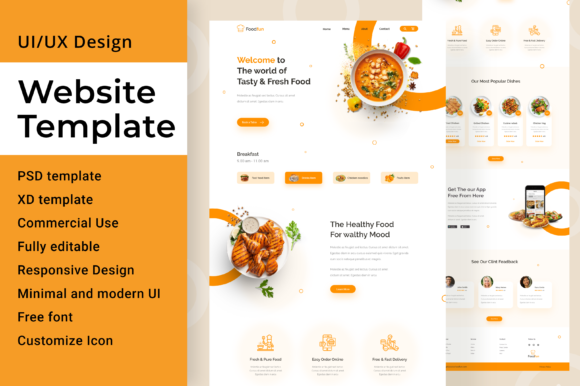
A Food Delivery Web Template UI (User Interface) Design refers to a pre-built layout for websites focused on the food delivery industry. It includes elements such as homepage layouts, menu sections, order forms, blog pages, and contact interfaces—each optimized for usability and visual appeal. These templates typically come in formats like Adobe Photoshop, Adobe XD, or Sketch, allowing designers to easily customize them before deployment.
The design often follows a 1140px grid system, which ensures responsiveness across different devices. They use RGB color formats, high-resolution images (150 DPI), and are built using free fonts and icon sets, reducing costs and simplifying the implementation process. Whether you're an entrepreneur launching a new delivery service or a small business owner aiming to revamp your site, these templates offer a professional starting point.
Common Mistakes When Choosing a Food Delivery Website Template
Many users make the mistake of selecting a template based solely on aesthetics without considering functionality. Here are some common pitfalls to avoid:
- Ignoring Responsiveness: Not all templates adapt well to mobile screens. If your target audience uses smartphones to place orders, a non-responsive design could lead to lost sales.
- Underestimating Customization Needs: Some templates may look great but lack smart layers or editable components. This makes it difficult to tailor the design to your specific branding or content requirements.
- Overlooking File Structure: Templates that don’t clearly separate files by page (e.g., Home, About Us, Blog) can become confusing during development and limit your ability to scale the site later.
- Assuming All Images Are Included: Most templates use placeholder images for preview purposes only. Failing to source your own high-quality visuals can result in a generic or unprofessional final product.
How These Mistakes Impact Your Business
Making poor choices when selecting a Food Delivery Web Template UI Design can have real consequences. For example, if a template isn't responsive, your potential customers might abandon their carts on mobile devices due to bad navigation or unclear buttons. Similarly, if the template lacks smart layers or editable components, you may end up spending extra time trying to modify it, increasing project delays and costs.
Using stock images instead of original content also affects how customers perceive your brand. A unique, visually appealing website helps build trust and reinforces your business's identity. Conversely, a poorly customized template can leave your site looking generic and unmemorable.
Practical Advice for Selecting the Right Template
To ensure you choose the best Food Delivery Web Template UI Design for your needs, consider the following tips:
- Review the File Structure: Check whether the template includes clear folders for each section (Home, About Us, Services, etc.). This makes it easier to manage and update your website over time.
- Test Responsive Layouts: Before purchasing or downloading, test how the template looks on various screen sizes. Many designers provide live previews or downloadable demos for this purpose.
- Check for Editable Layers: Ensure the template is smart layer-based so that you can tweak elements like colors, fonts, and spacing without breaking the design. This is especially important if you're not working with a developer who can code changes manually.
- Confirm Licensing Terms: Understand what you’re allowed to do with the template after purchase. Some templates are for personal use only, while others permit commercial applications or multiple projects.
- Plan for Original Content: Remember that all images provided in the template are for preview. Source your own photos and icons to maintain authenticity and professionalism.
Example: Better Approach for a Local Pizza Delivery Service
Imagine you run a local pizza delivery service and want to launch a new website. You find a Food Delivery Web Template UI Design that features a vibrant homepage with food illustrations, a clean menu section, and a blog for sharing promotions. However, upon closer inspection, you notice that the template doesn't support multi-language options and lacks a dedicated section for customer reviews.
Rather than proceeding blindly, you should compare this template with alternatives that include those features. Look for a template with a more flexible structure, possibly one that allows adding custom modules or supports localization. This way, you future-proof your website and enhance customer engagement from the start.
Things to Check Before Downloading or Purchasing
Before committing to a Food Delivery Web Template UI Design, take time to evaluate the following:
- Software Compatibility: Confirm the template works seamlessly in Adobe Photoshop, Adobe XD, or Sketch, depending on your preferred tool.
- Resolution and Quality: High-resolution assets (like 1920 w × 8000 h px layouts) are crucial for professional printing and large-screen displays.
- Font and Icon Usage: Verify that the fonts and icon sets used are free and properly licensed for web use. Some premium-looking fonts require payment even if they appear in the template preview.
- Technical Support: Does the provider offer assistance if you encounter issues during customization? Reliable support can save you hours of frustration.
- Updates and Maintenance: Will the template receive regular updates to stay compatible with new software versions and trends? An outdated design can harm your website’s performance and SEO rankings.
Realistic Scenario: A Freelancer’s Template Dilemma
As a freelance designer, you might be tempted to use a Food Delivery Web Template UI Design quickly for a client's project. But if you don’t check the licensing terms, you could face legal complications down the line if the client wants to use the same design for another business. Always review the template’s documentation and confirm it allows multiple uses if needed.
Additionally, if the template doesn’t support modern design practices or has a cluttered file organization, it will take longer to implement and may lead to inconsistencies. Opt for a template that balances speed of setup with long-term flexibility and scalability.
Conclusion
A Food Delivery Web Template UI Design can be a powerful tool when chosen and implemented wisely. By avoiding common mistakes like ignoring responsiveness, skipping technical checks, or assuming included assets are available for use, you set yourself up for success. Always prioritize usability, customization options, and clarity in file structure when evaluating your choices.
With the right template, you can create a polished, professional website that enhances your brand image, improves customer interaction, and boosts your bottom line. Take the time to research and select a template that aligns with your goals and grows with your business.